Boom remains upbeat on delayed supersonic airliner
Boom remains upbeat on delayed supersonic airliner
By Steve Creedy Sat Jun 29, 2019
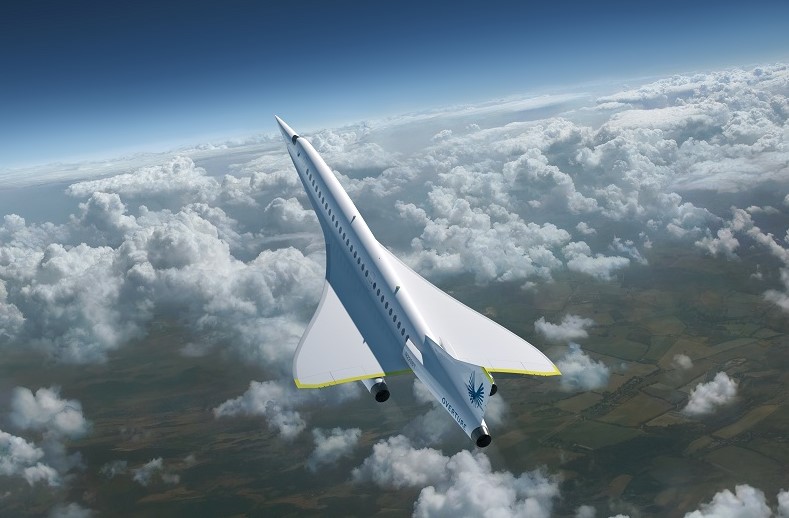
Boom Supersonic, the “only private supersonic company on the planet funded all the way through to flight test” with the testbed XB-1, is due to take to the air in early 2020, says chief executive Blake Scholl.
Scholl told AirlineRatings in an exclusive interview at the Paris Air Show that a slight slip in the previously announced timeline meant Boom would roll out its twin-seat XB-1 demonstrator aircraft from the company hangar in Denver, Colorado in December of this year.
The first of many thousands of test-flight hours is planned for early next year.
The company has currently raised $US150m of funding and Scholl said most of it was still in its bank accounts.
READ: 4K monitor replaces front window in new supersonic NASA X-plane
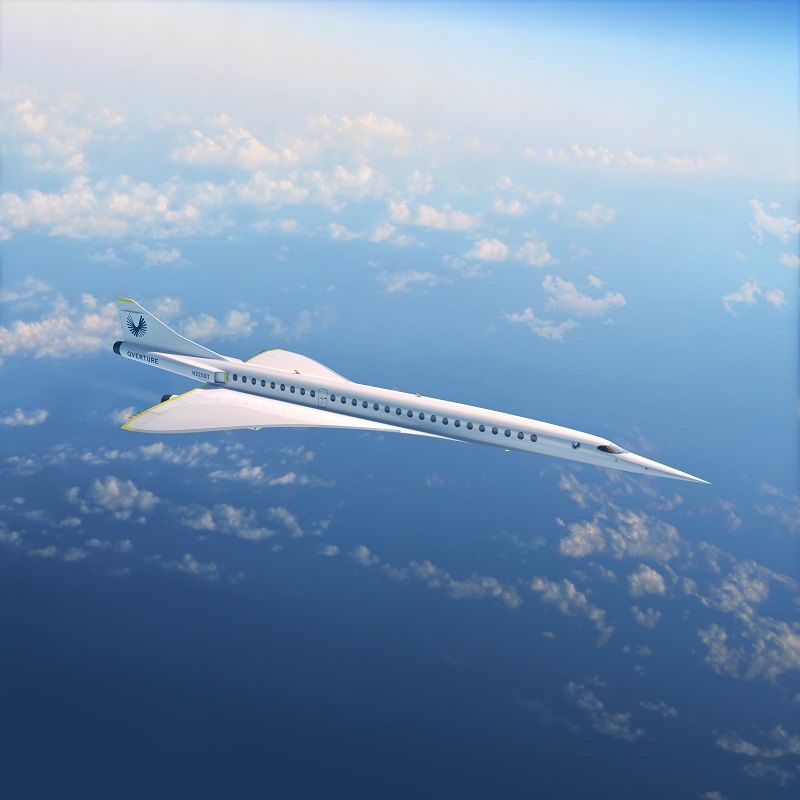
He said much more fund-raising would need to be done to raise the billions of dollars needed before the actual 50-seat supersonic airliner, called “Overture”, would be assembled.
The timeline for the planned entry into airline service has now also slipped to some from the previously envisaged 2023-24 to between 2025 and 2027.
But Scholl revealed interest among airlines was huge, adding: “We talked to almost every airline doing long-haul on the planet”.
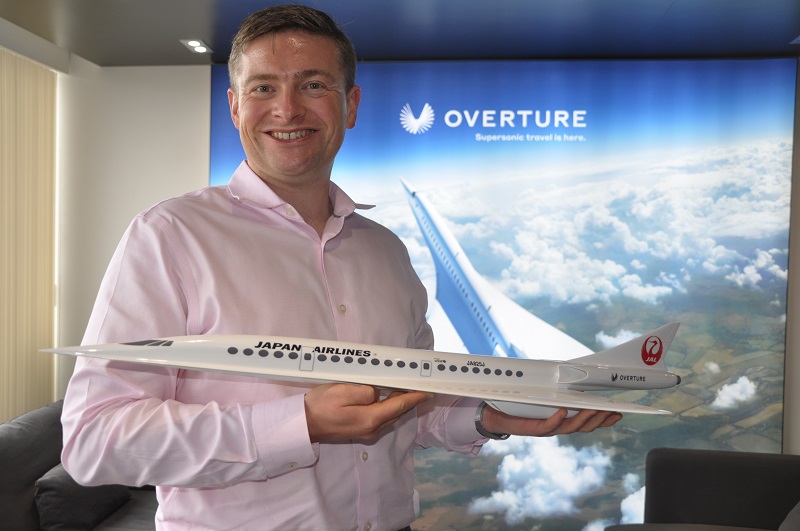
Boom’s first major airline partner in the development of the first privately built supersonic airliner and the second ever after Concorde, retired in 2003, is Japan Airlines (JAL) with an option for 20 aircraft.
“The important role of JAL is to help us make the aircraft practical, they help us with passenger experience and operations”, said Scholl.
The Boom chief joked that the monthly meetings, alternating between Tokyo and Denver, meant “we are especially keen on doing these flights supersonically in the future.
“We’ve already learned a ton from them and they’ll help us to build an aircraft that they’ll be happy to have as well as many other airlines.
“They want to enjoy a first-mover advantage in supersonic and have invested 10 million dollars.”
Boom CEO Blake Scholl. Photo: Andreas Spaeth
The deal with JAL was something that didn’t come lightly but was the result of a thorough two-year evaluation process behind the scenes. The project’s other airline partner, with ten aircraft options, is Virgin Atlantic.
“You want airlines that understand the dynamics of different markets, the Pacific is very different than the Atlantic,” said Scholl.
“It is very likely that the layout of the aircraft will be different between the two. You want just a handful of airlines that you can get really close to. And that helps you build an aircraft that a large number of airlines want to have.”
It might be a marketing challenge for Boom, Scholl admitted, to convince the public that an aircraft looking to the layman like a fighter jet is actually the prelude to the return of supersonic passenger flight.
“Though they look different, there is actually a lot of commonality between XB-1 and Overture,” Scholl insisted.
“First and foremost, the materials are very similar. The high-temperature composites that allow us to go Mach 2.2 are common between the two airplanes.
“The engines are different, but the inlets are directly transferable. We were able to beat Concorde’s inlet performance by five percent, which is huge.”
One of the major challenges on the way to introduce “Overture” into airline service is the unsolved choice of engines to accelerate the airliner to speeds of up to Mach 2.2.
“There are multiple good engine options out there, and we are going to pick either one or two partners for that down the road,’’ Scholl said.
“But only when we have enough fidelity in the design so that we know we make the right choice.
“There are different options, besides using an existing engine there is also a potential to do something clean-sheet. Not a new technology engine, but a newly designed engine.”
Even though the current climate in most Western societies, especially among very young people, is turning more and more hostile against flying in general due to its perceived impact on climate change, Scholl is optimistic he can deliver the seemingly impossible.
“You have to design the aircraft and all its systems so that it will be a positive for the world so that you can have the benefits of supersonic flying without the downsides,” he noted.
But already he had had to adapt the business model of Boom since first announcing the project at the 2017 Paris Air Show.
“The story two years ago was that we are going to match the efficiency of subsonic Business Class, so there won’t be a step backward,’’ he said.
“But what we realized since then that there is going to be an explosion of air traffic with supersonic, so matching isn’t good enough, we actually have to be better.
“That’s why we are heavily investing in alternative fuels, that’s why we’ve done biofuel testing on XB-1 already. Thanks to our new partnership with Prometheus Fuels it’s literally carbon neutral.
“If you’ve got a noise footprint that’s no different from what’s flying today and literally no carbon footprint, then the downsides just aren’t meaningful, and we can all get excited about the upside.”
Image: Boom
He still has work to do to convince airlines and potential investors that Boom can actually pull it off.
“There have been a lot of false starts at supersonic. This is different,” Scholl stressed.
“We have the intersection between the market – international travel has doubled since Concorde retired – and technology.
“The things you need technologically are now proven. We’ve got carbon-fiber composites, we’ve got efficient turbofans and many more things, they are out there flying, not existing just in a lab.
“Now with XB-1 coming we are no longer theoretical; we are literally coming together.’’
At the same time, Scholl is well aware that the project for a supersonic passenger airliner still hinges on many ifs.
“Overture is one of the most complex, safety-critical machines ever built,’’ he stressed.
“It’s a high level of complexity, not least because of the involvement of multiple suppliers, and we know that manufacturing is hard.
“So there is a lot we have to get right, but there are no showstoppers.”